Isaura
From ancient greek, Ισαυρία: an ancient rugged region in Asia Minor.
This city computes tracks and extracts topology information from deconvoluted hits (ddst). Therefore, it is analogous to the final stage of Esmeralda. Unlike the latter, the input hits correspond to the deconvoluted ones coming from Beersheba (instead of Penthesilea), allowing us to obtain a finer tracking of events.
Input
/Run/events
/Run/runInfo
/DECO/Events
/DST/Events
Output
/Tracking/Tracks: tracking-related information of events (in particular: track energy (energy), track length (length), number of voxels (numb_of_voxels), number of hits (numb_of_hits), minimum and maximum position computed with the hits comprising the track (x_min,y_max, …), blobs position (blob1_z,blob2_x,…) and energy (eblob1,eblob2), energy of the hits shared by both blobs (ovlp_blob_energy), and voxel size (vox_size_x,vox_size_y,vox_size_z). Each row corresponds to a different track, specified among the others within an event with itstrackID.
/Summary/Events: global information related to the event. Each row is one event.
/DST/Events: copy of the point-like information (kdst) of events, output of Penthesilea.
/Filters/hits_select: flag to indicate if an event passes the selection of having more than 0 hits.
/Filters/topology_select: flag to indicate if an event passes the selection of having less hits than themax_num_hitsparameter specified in the config file.MC info: copy of the Monte Carlo information for the events that the city outputs. Only if
run_number< 0. The tables included are:/MC/configuration,/MC/hits,/MC/particles,/MC/sns_positions, and/MC/sns_response.
Config
Apart from the Common arguments to every city, the parameters to run Isaura are the following:
Parameter |
Type |
Description |
|---|---|---|
|
|
X, Y, and Z dimensions of the voxels used in the voxelization of the hits. |
|
|
Flag to indicate if the size of the voxels is forced to be exactly the values provided in the previous argument (True), or, on the other hand, if they are allowed to change a bit for each track, aiming to optimize the voxelization process (False). |
|
|
If the energy of one of the original end-point voxels is smaller than this value, the voxel will be dropped and its energy redistributed to the neighbours. |
|
|
The voxel dropping procedure commented in |
|
|
Radius of the blobs. |
|
|
Maximum number of hits for an event to be processed. Events with more hits are filtered out and their ID will not appear in the |
Workflow
The basic idea behind Isaura is to run the “traditional” Paolina algorithm over the deconvoluted hits output in Beersheba, in order to convert events into tracks with blobs. This process can be divided into two main steps:
Event selection based on the contained hits
First of all, it is mandatory to perform some selections concerning the number of hits that events contain, in order to be able to compute all the tracking information for each of them.
The first condition that all events must fulfill to be processed is to contain at least one hit. If that does not happen, the event will be rejected, which will be displayed in the table Filters/hits_select.
The next step within the algorithm consists in checking that the number of hits is lower than the value provided in the config file (max_num_hits). That argument was introduced because, when running Paolina algorithm after Penthesilea, there were some events that comprise such large amount of hits that the tracking information extraction took a ridiculously long time. The following picture shows the number of Penthesilea hits (hdst) per event (with a different scale) for a typical 24h-long low-background run included in the NEXT-White double-beta analysis [1]. High energy (trigger2) events usually contain around 200 Penthesilea hits (as right panel points out), while there are some with more than 10000 hits (illustrated in left panel).
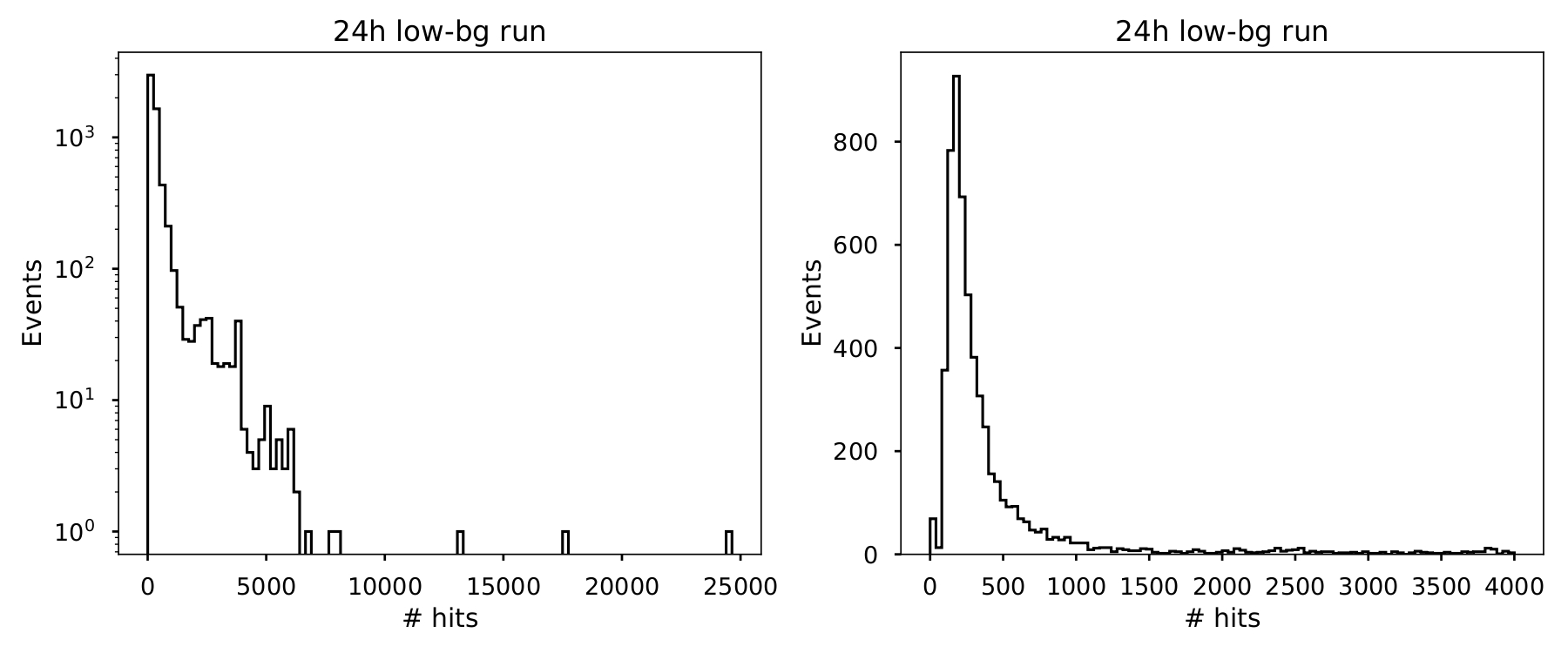
The plot also shows that these events only appear a few times within a 24h-long low-background run (around 0.05% of the total set of events). Rejecting this type of event is not a particularly worrysome issue: they would be thrown away in the posterior analysis, owing to the fact that none of them are exclusively contained inside the fiducial volume. The spatial distributions for one of these events is presented below (where the grey dashed lines illustrate the boundaries of the chamber).
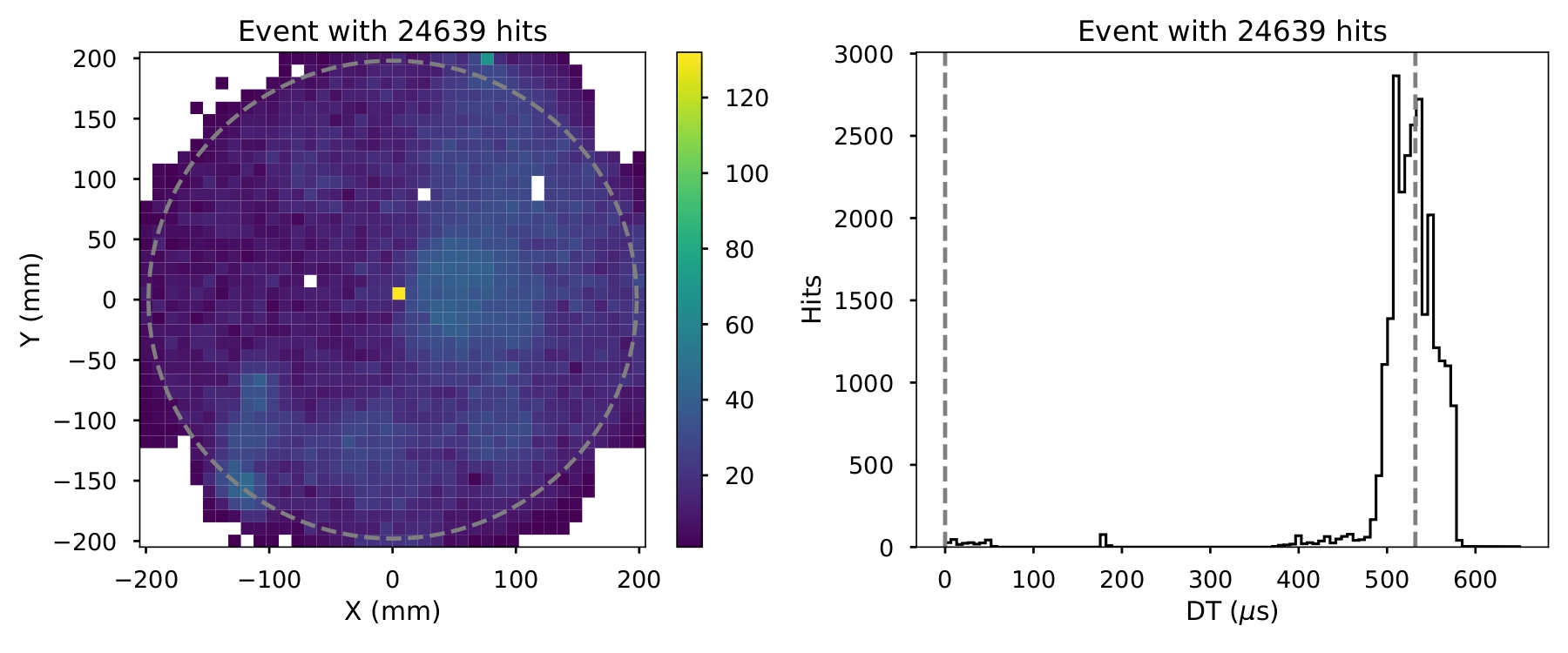
In any case, one can easily infer from the plots that these events are not physical. On the contrary, they seem to correspond to either some kind of flash occurring in the chamber (like a mini-spark) or some fail in the electronics (after the saturation of an alpha particle, for example). The ID of the events that are removed from the reconstruction chain because of this reason will be specified in the table Filters/topology_select, in order to keep track of this information.
Finally, every event is also required to contain hits with well-defined energy. That could happen when all hits for a specific event are outside the krypton correction map boundaries. For them, Esmeralda is not able to correct their energy, and the Ec variable (corrected energy) –used for running in Esmeralda the same topology-related algorithm as here (explained below)– is set to NaN, making the tracking process impossible.
Extracting the topology-related information
An excellent topological discrimination between signal and background (thanks to the usage of a gaseous medium inside the TPC) is one of the fundamental trademarks of the NEXT experiment. That is achievable thanks to the exploitation of the so-called blobs. They are defined as imaginary 3D spheres located around both ends of each track. Their energy is an excellent tool to investigate whether there has been a large and sudden energy deposition in the track extreme (i.e. Bragg peak, indicating the stopping point of a charged particle) or not (starting point of its trajectory). Therefore, that will be a crucial stage within the reconstruction chain, since if it is performed correctly, it will allow separating double-electron (such as the double-beta signal) from single-electron (the majority of backgrounds) tracks.
In order to achieve that, it is necessary to:
The following subsections explain each of these processes in detail.
Separating events into tracks
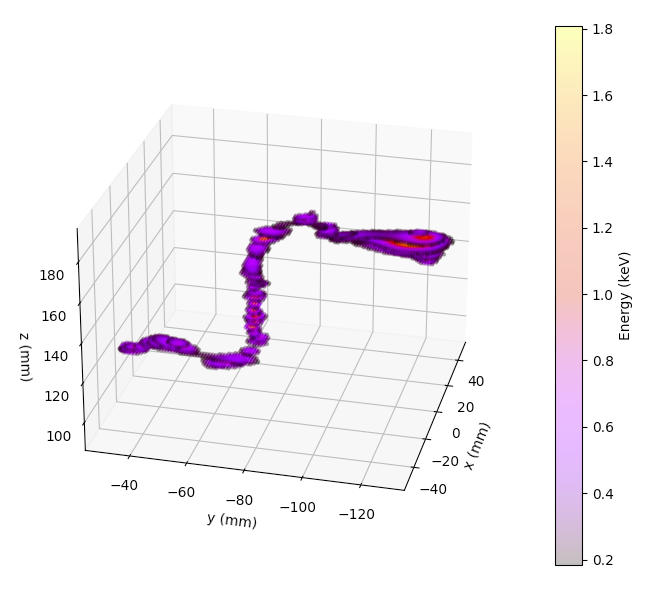
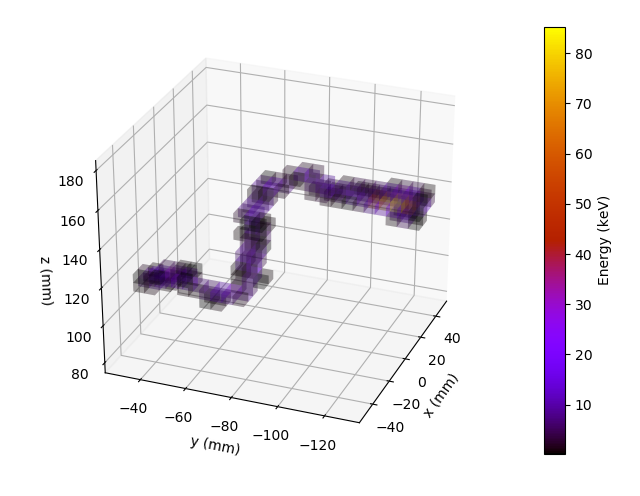
Once events are properly selected according to the previous subsection, their hits are grouped into 3D volume elements (voxels) with the objective of studying the connectivity. The size of these voxels is more or less fixed (depending on the strict_vox_size parameter in the config file), and their energy correspond to the sum of the energy of the hits included in the voxel. Following a Breadth-First Search (BSF) [2] algorithm, the voxels sharing a side, edge, or corner will be part of the same track. The figure below shows the voxelization result of a real NEXT-White data (Run-VI) single-electron candidate of 1.73 MeV. In this case, after grouping the deconvoluted hits into [5 mm x 5 mm x 5 mm] voxels, the event was classified as single-track.
Searching blobs position
To compute the position of the blobs, we need to find the two extreme voxels of the track, which is done following the BFS algorithm. Then, as the figure below illustrates, the energy-weighted averaged position of the hits (represented with red stars) inside each extreme voxel will correspond to the blob center (represented with the black dot from where the grey arrow starts).
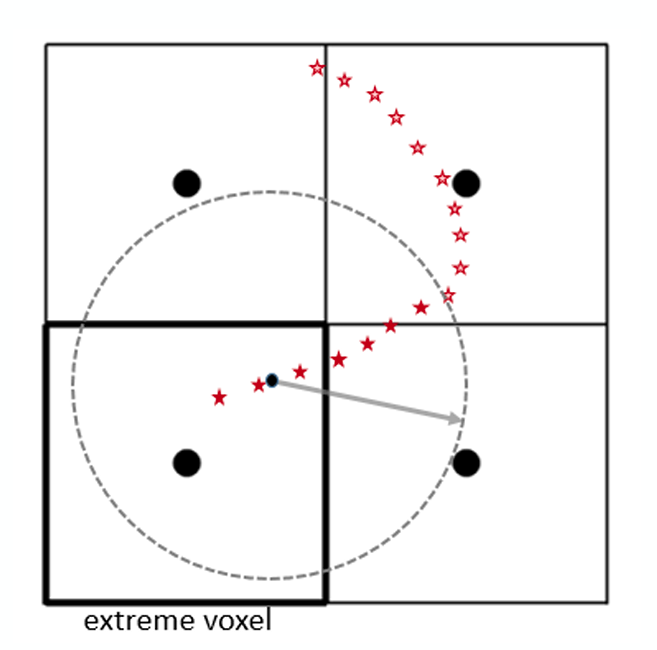
The first thing to do is to localize the two end voxels for each track. Defining the distance between any pair of voxels as the shortest path along the track that connects them, the two extreme voxels will be the ones with the longest distance between them. However, there are two special cases that are important to comment:
It is possible that some spurious low-energy hits appear around the track (due to over-iterations during the Richardson-Lucy deconvolution process, as commented in Beersheba; or some noise inside the chamber, for example). If these hits are reconstructed around the track but not far enough to produce a different S2 or track (taking into account the voxel size), they can be considered as a part of the main one and, being a bit separate, it is probable that they end up belonging to an extreme voxel. That case would not be correct, and in order to solve it, the voxel will be dropped from the track and its energy passed to the closest one. This process is only carried out if the voxel energy is lower than
energy_thresholdand the track is made by more thanmin_voxelsvoxels. Once this procedure is done, the extreme voxels are searched and found again recursively, until none of these conditions are fulfilled.Another particular scenario is the one that comes up when there are multiple end-voxel candidates (one can imagine that the shorter the track the more probable this is to happen). To deal with it, the more energetic candidates will be the ones set as extremes. With this convention, we aim to minimize the use of the voxel-dropping algorithm commented above for those cases where the energy of one candidate is larger than
energy_thresholdwhile the other one is below that value.
Once the extreme voxels are properly found, the center position of the blobs –stored in the Tracks/Tracking table as: blobi_x, blobi_y, and blobi_z, (with i being 1, 2), respectively– is computed in accordance with the figure previously presented.
Blob energies computation
From these blob centers, 3D spheres of radius blob_radius (specified in the config file) are taken. The hits inside the sphere will contribute to the energy of the blob, that will be stored as eblob1 and eblob2 [3]. It is relevant to take into account here that not every hit falling inside the blob sphere will be considered for its total energy, but only the ones that belong to a voxel adjacent to the one labeled as extreme.
The final step of the Paolina algorithm includes the computation of the ovlp_blob_energy (“overlap blob energy”) variable: in short tracks it is common to have overlapping blobs, i.e. blobs that share some of their hits [4]. In these cases, the eblobi variables become meaningless, since the energy of these hits would contribute to both blobs [5]. Therefore, it will be interesting to reject this type of event during the posterior analysis in case the blob energy distributions are intented to be exploited. Owing to the fact that the aforementioned variable is defined as the total amount of energy of these shared hits, a selection of ovlp_blob_energy = 0 will get rid of the corresponding events easily.
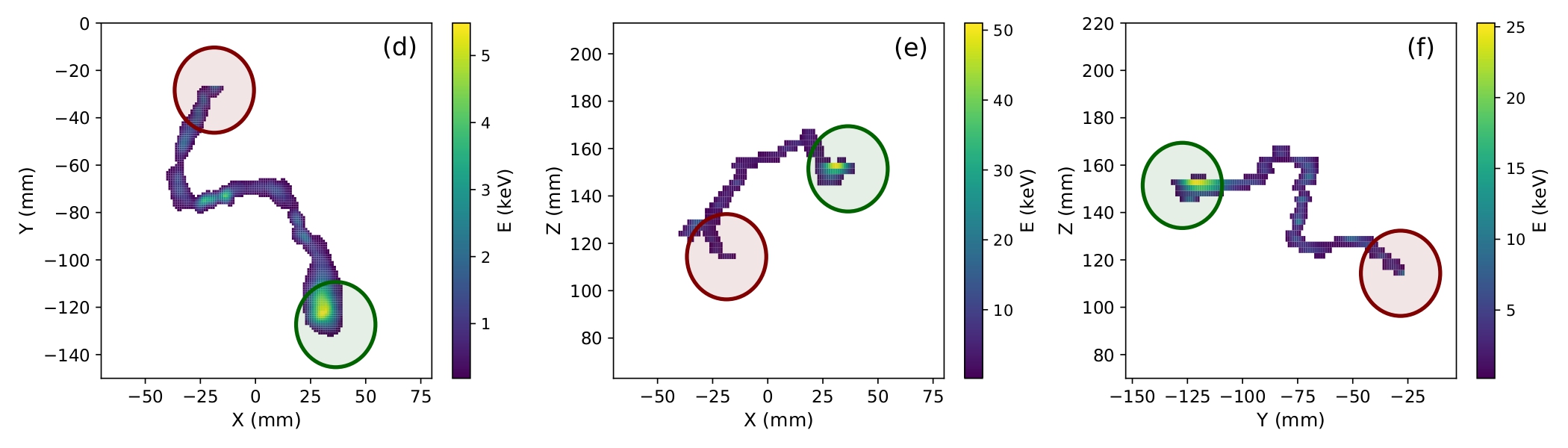
The XY (d), XZ (e) and YZ (f) projections of deconvoluted hits, along with the blobs computed with this algortihm, for the same event as the one shown before (in the voxelization plot) can be seen above. This image illustrates how the blobs seem to be computed perfectly. According to our reconstruction, it corresponds to a clear single-electron event (background), due to the noticeable difference between the energy of its blobs: eblob1 = 755 keV, whereas eblob2 = 104 keV.
Isaura comprises the last step within the NEXT reconstruction chain. Therefore, after it, we have access to all the relevant information to perform the analysis. This information is finally stored in different tables, as the Output subsection indicates.